
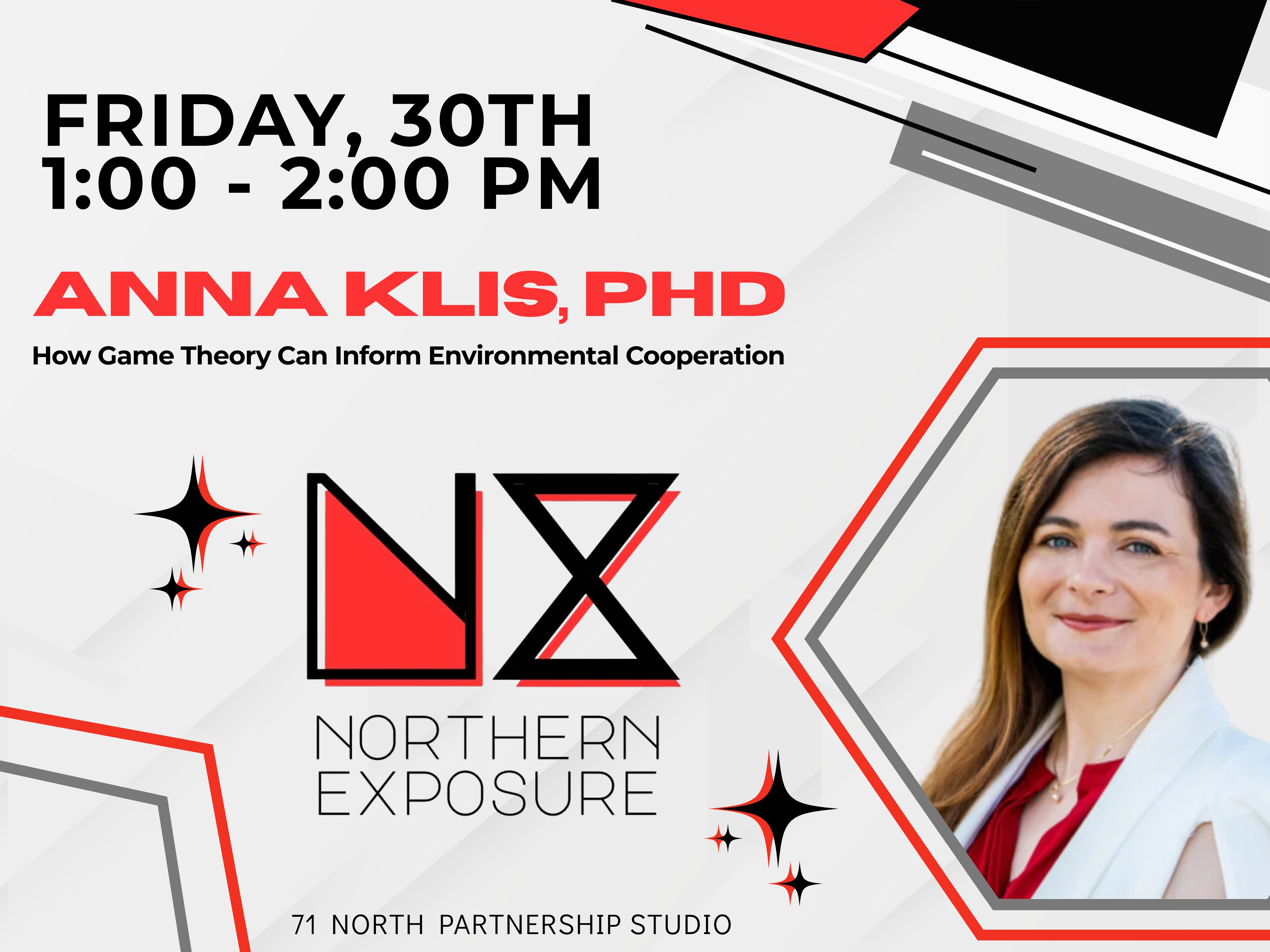
Kicking off the Spring 2026 semester of Northern Exposure, we had the pleasure of welcoming Dr. Anna Klis, associate professor in the Department of Economics and a familiar face around the 71 North Studio. Dr. Klis presented her work, “How Game Theory Can Inform Environmental Cooperation,” offering an engaging look at how economic models can help us understand collective action on environmental issues.
Dr. Klis’s research focuses on the cooperation needed to address challenges such as overfishing, climate change, and emissions reduction. Rather than treating these issues in isolation, her work examines how different “players” interact, how incentives shape behavior, and how individual decisions combine to produce broader societal outcomes.
During the talk, Dr. Klis introduced two foundational structures of game theory: the Prisoner’s Dilemma and an extensive-form game. By walking us through each model step by step and mapping out players’ choices on the board, she demonstrated how strategic thinking influences real-world decisions, especially in situations where cooperation is possible but uncertain. Drawing from her co-authored research, Dr. Klis also discussed carbon taxing as a way to encourage environmental cooperation between countries. Framed through a game-theoretic lens, this approach highlights how well-designed incentives can promote collective action and more sustainable outcomes. Dr. Klis emphasized, however, that there is no simple solution to achieving cooperation at a global scale. Future work will need to expand these models to account for greater complexity and real-world constraints.
Overall, the talk offered a powerful reminder that human behavior is interconnected and that our choices carry lasting consequences. We look forward to Dr. Klis’s continued work and to seeing her around the studio as she co-facilitates Innovation Pages at 71 North: Ecosystems as Models for Restoring Our Economies.