
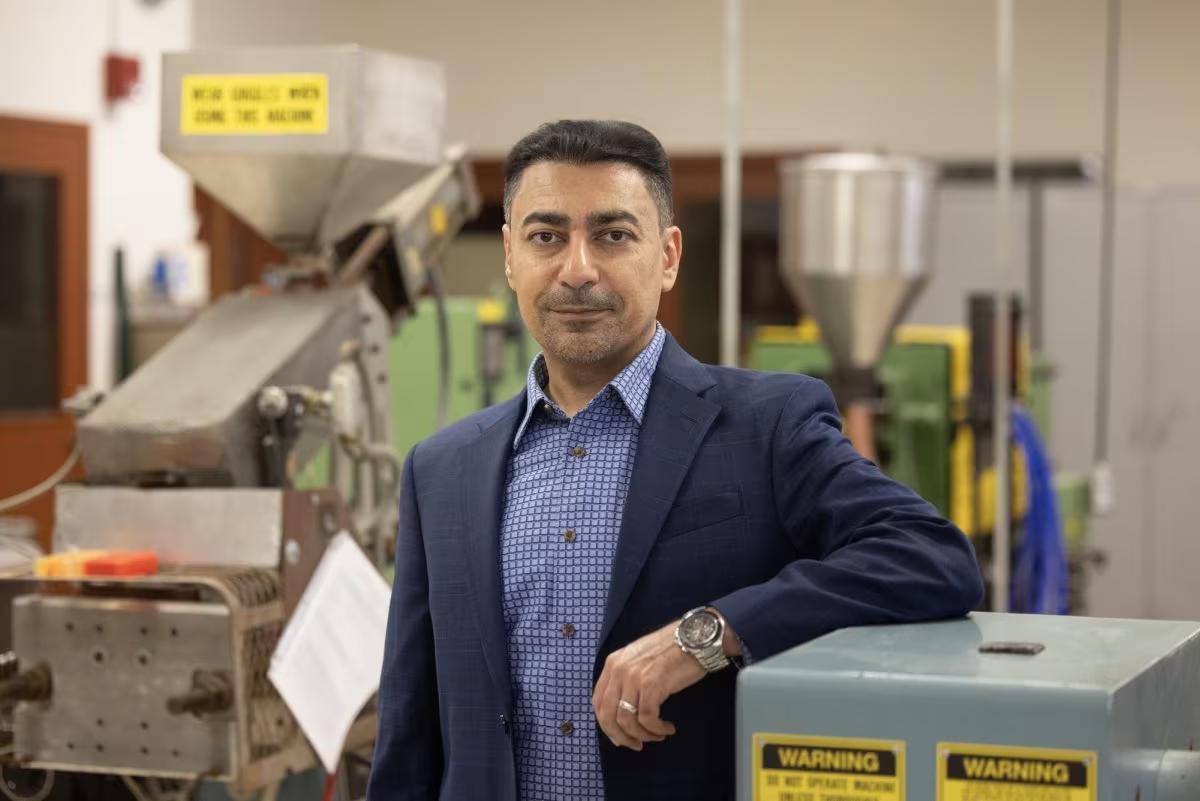
Dr. Mahdi Vaezi brought the NIU Bioplastics Lab to Northern Exposure in February, passing soy-based utensils and hemp materials around the 71 North studio. Read our recap of his talk, then meet the researcher behind the work.
One of Mahdi Vaezi’s inspirations to pursue engineering is his father.
“My dad is an engineer. I always watched him working with all tools and machines. I think he was, and still is, a big inspiration for me to get me excited about working with all those tools and devices,” Vaezi said. “The closest field I found to be able to further work with and learn about this stuff is mechanical engineering.”
Vaezi is an engineering technology associate professor and the director of NIU’s Waste Advanced Solution Technologies and Ecosystems Lab, shortened to WASTE, which focuses on renewables and engineering.
Vaezi studied for his master’s in mechanical engineering at Ferdowsi University in Mashhad, Iran, eventually obtaining his doctorate at the University of Alberta in Edmonton, Canada.
“I was instructor and postdoctoral fellow for three years before I joined NIU in 2017. Meanwhile, I have worked in a few places like in a power plant, also in an HVAC company as an engineer, design engineer,” Vaezi said.
Vaezi joined mechanical engineering at NIU as he preferred working in academic research over working directly in the industry.
“I pretty much loved working in a research environment to be able to work with researchers, work with industry, government, state agencies, administrations to further develop knowledge and science, particularly in engineering,” Vaezi said. “That’s why I stayed away from industry and searched for academic positions. Thankfully, by that time, the Department of Engineering Technology was looking for someone expert in renewable energies, and that was my field of research.”
While studying mechanical engineering, Vaezi got interested in renewable energy and what it can do for engineering.
“When in my master thesis, I started working on converting renewable sources of energy and clean energy production. That continued into my Ph.D. thesis as well,” Vaezi said. “I was exposed to renewables since master, and that kept me excited and interested in this field.”
Vaezi’s interest in renewable energy led to him running WASTE, which is composed of two labs.
“One is a Hydrotransport Lab, which is focused on transporting and logistics of biomass. It’s a source of waste, or we later called it residue. The other one is a Bioplastics Lab, which is a hub to convert waste or residue into bioplastics, biocomposites,” Vaezi said.
Vaezi said some of the biomass residues used include wheat, straw and wood chips.
WASTE Lab collaborates with companies like Biofine Developments Northeast to get biomass and help them with their waste.
“Our major clients are agricultural sector and forestry sector,” Vaezi said. “So, in some cases, they have to actually pay in order to get rid of the waste. We help them not only save that money, but also make additional money by processing and turning these waste into value-added products that could sell at way higher prices,” Vaezi said.
Vaezi also said he believes engineering is an important job that can lead to higher opportunities.
“Everything starts with them being engineers. For you to be a good manager, you first need to be a good engineer to be able to manage other engineers, so down the road, even if you think you’re going to be a manager administrator, you better be a good engineer first,” Vaezi said.
Originally published by the Northern Star, written by Maxwell Mathew. Photo courtesy of Mahdi Vaezi.