
Next in Line
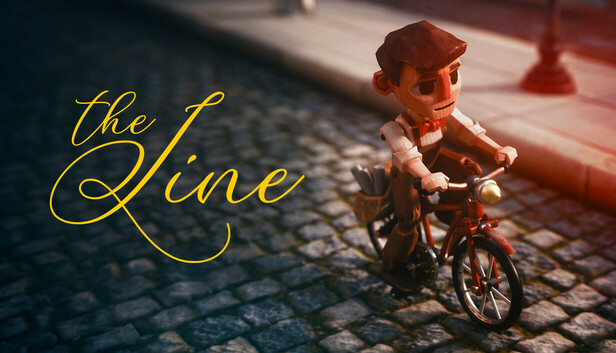
Each virtual reality experience I’ve entered thus far has felt like a passage through a different kind of humanity. In EMPEROR, I stepped into the quiet isolation of a father’s mind and story, feeling language slip away like sand between fingers. In MLK: Now is the Time, I stood within history’s echo, reminded that justice—like empathy—requires presence, patience, and understanding. Now, in The Line, a virtual reality narrative by Arvore Immersive Experiences, I found myself somewhere smaller—viewing a miniature world of routine, repetition, and delicate motion.
Walking the Invisible Path
The story of The Line unfolds like a mechanical storybook—gears turning, doors sliding open, an endearing little love story, and miniature figures repeating their daily motions with precision and predictability. I spent roughly fifteen minutes reviewing this narrative. The first time I entered the world, it was just a regular Sunday after work for me. Which, in general, means I was exhausted and bored. Going through the VR narratives in those times provides me with engagement and, overall, something much more productive than doomscrolling on my phone.
This VR was highly interactive; multiple times during the experience, you are prompted to move the line along and help the petite protagonist, Pedro. An aspect I appreciated about this experience was that it is offered in a wide range of languages, including English, French, Chinese, Spanish, and a few others. Additionally, the experience gives participants the choice to stand and move throughout the narrative or sit and enjoy, which is something I have yet to see in any of the VRs thus far. And though I expected the interactivity, little did I anticipate to be reflecting on my life after the final rotation of the miniature world.
The Line is charming and beautiful, but beneath the surface, it’s melancholic. Every rotation reminds us of the invisible tracks we walk in our own lives—those of expectation, repetition, and fear of disruption or rejection. Personally, as I moved through this miniature world, I felt the subtle ache of recognition. The predictability and comfort of routine, mirrored in Pedro’s daily dance, echoed moments in my own life when habit and fear of change kept me from stepping outside the familiar. There was a quiet vulnerability in participating, even virtually, in cycles so close to those I know; longing, hesitation, and the tension between comfort and happiness. This narrative prompted me to reflect on my own rituals: the small daily choices I rarely question, and the unseen courage it takes to break them.
Ritual and the Mechanics of Life
At first glance, The Line is enchanting; a diorama of a small town and two little lovers, Pedro and Rosa. Beneath that mechanical beauty, however, lies a profound metaphor for human ritual. The basic crux of The Line is the simple fact that these characters are following a set path. They are placed into a fixed daily routine that they repeat with every rotation. Even the narrator comments on the repetitive nature of the world, playfully betting you about the next occurrence in its sequence. The blue car goes this way, the tram arrives at this time, the crossing guard waves, the lawn is “watered”, and little Pedro rings his bell, then “tosses” a paper from his bag to the doorstep. As the cycle repeats while you go through the narrative, you experience the predictability firsthand.
Anthropologically speaking, ritual is more than just grand ceremonies; it’s the rhythm of daily life. Clifford Geertz wrote that humans are “suspended in webs of significance he himself has spun” (The Interpretation of Cultures, 1973). The “webs”—culture—represent the systems of meaning, values, and symbols we create and share. This refers to the language, religion, or our overall social customs of the cultural framework we are born into and live in. These aspects ultimately shape our thoughts, behaviors, and perceptions of reality.
Along those anthropological lines, The Line can be seen as a performing culture for us to study. There are many diverse ways individuals reflect and create their cultural norms through their daily activities, interactions, and behaviors. They can highlight our identities and personal traits. Additionally, it can either reinforce existing norms or resist and reshape them. Social realities and meaning, much like identities, are not inherent but are actively constructed through daily life performances. The patterned flows and ongoing performance reflect the real lives of real people, as I saw in my own reflection through this narrative.
We wake, work, and rest within invisible systems of culture that guide us, but can also restrain us. The Line embodies that structure: gears turn, paths connect, and people move along them because they believe they must. But in The Line, as in real life, this mechanical order can become suffocating. The beauty of this VR piece lies in its invitation not just to watch the system, but to feel the quiet tension within it—to sense what it costs to keep turning in circles when the heart wants to wander off the track—and to participate in helping the path be deviated from.
Love on The Line
Though routine is the crux, love is the catalyst in The Line. You can say some things are cliché, but someone giving a flower to their crush is one of the sweetest acts of subtle affection, in my opinion. Pedro’s little transgression from the usual cycle in picking a yellow flower from the trees to give to Rosa is a small act, but it takes a lot of courage. Especially because he, in his prescribed path, is not supposed to do so, nor designed to. But it only goes to show you that love is a powerful force that instills drive and passion in people. To the extent that someone would break their routine to show you what you mean to them.
Similarly, as a florist, Rosa has no use for more flowers when she can “grow” her own in her day-to-day. However, she comes to expect the little yellow flowers Pedro leaves for her. They are revealed to be her favorite, a graspable sunshine in her typical garden sky of roses. But not only does she fancy the flower, she fancies Pedro as well, causing the flowers to mean an appreciable amount to her. She keeps every flower Pedro has given her in each transgression he took from his established path—something I found a reflection of myself in as well; when I receive my favorite flower from the person I have deep feelings for, I keep a handful of petals. Keeping the little flower is more than just a memento, but a lasting reminder of a feeling one wishes to sustain. A reminder that someone feels so deeply about you that they will go out of their way to show you what you mean to them.
Each time Pedro passed by Rosa, I found myself cheering for him to go to her and talk to her. Hoping that he’d break his routine even more so that he and Rosa can express their feeling for each other—I’m a sucker for a good romance. However, after Pedro deviated from the line so many times, the tree eventually ran out of reachable flowers, and he lacked his little gift for Rosa. Like the barren branches, Pedro’s days began to lose the color and vitality that once brightened his routine. Rosa’s routine became the same, with no flower from Pedro, all she is left with is a thorny view of her routine. I was even left with a sorrowful feeling that maybe their lines would never merge. Yet, it’s often on unfamiliar paths that we discover the flowering light leading us toward the love we seek.
Breaking the Line
When Pedro would normally go straight in the path, he takes a turn and goes down an unknown path. All because he spies the last yellow flower in the mini world to give to Rosa. Meeting this larger transgression with encouragement from the narrator and me, Pedro reaches the tree at the top of the hill. But in his rush to get the flower to Rosa, he loses control and crashes through the floor of the diorama, sending him down below his known world.
In the moment Pedro crossed the boundary—to ride off the line—he embodies a universal moment of rupture. Anthropology often examines what happens when people step outside of prescribed paths: when individuals or communities redefine tradition, love, or destiny. The act of going against cultural norms is seen as almost taboo. Norms are built up over time and in community; when you go against them, you are going against what you are a part of and a part of yourself. The act of crossing over, of “breaking the line,” is both terrifying and liberating; you may have a moment of crash where you need to pull yourself together or up, but through that, you gain a rush of adrenaline from your newfound courage to finally reach what you are working towards.
When Pedro is finally able to climb out from beneath the diorama, with your assistance, yet in the process losing the flower, he becomes brave enough to go to Rosa and actually talk to her this time. The Line blooms—literally and symbolically—in that moment. The flowers Rosa has kept scatter the landscape, radiant, breaking through the mechanical monotony. They become the language of rebellion, the natural world pushing against the artificial boundaries of habit and fear. With your final intervention, the flowers fly, creating a new path for Pedro to Rosa, allowing them to reach each other with no restraint from the line they were initially placed on.
Pedro’s story can be deeply inspirational. Many people, much like myself, have felt restraint placed upon them by varying factors. Not knowing when or how to break through can be scary and confusing. You think you might fall through the floor, much like Pedro “literally” did. However, defying what may scare us leads to the chance of getting something we’ve wanted for so long. Our lives can bloom and reconfigure in a way that frees us from humdrum, ultimately giving us the ability to grow and discover things for ourselves, free from the invisible track and unafraid.
VR as an Ethnographic Lens
What makes The Line remarkable as a virtual reality experience is its ability to place the viewer within this mechanical world—not as an observer, but as a participant in its rhythm. You are surrounded by gears and rails, by the repetition of daily ritual, until you begin to question your own. The Line presents an experimental kind of ethnography, allowing us to inhabit a symbolic world that mirrors our own cultural constructs. We don’t just learn about routine and resistance, we feel them, embodied through motion and space.
The essence of an ethnographic experience is to immerse, to observe, to feel, and to reflect on what we experience and participate in. VR, at its best, can blur the line between observer and participant, transforming theory into sensation. Through these immersive narratives, we witness how systems shape identity—and how courage, even in its smallest form, can reshape the system.
Closing the Loop
Each of these VR worlds—EMPEROR, MLK: Now is the Time, and The Line—has traced a different path toward understanding what it means to be human. Together, they form a kind of anthropological trilogy: one of empathy, justice, and freedom.
The Line reminds us that breaking patterns is an act of creation. To step off the track is to risk chaos, but also to invite growth—to make room for new meaning, new ritual, new love. Perhaps the most profound lesson The Line offers is that it reminds us that to live fully, we must sometimes stop the gears, challenge the rhythm, and choose a new line to follow—one drawn not by habit or fear, but by the call of desire, courage, and human connection.
After all, fortuna audaces iuvat.