
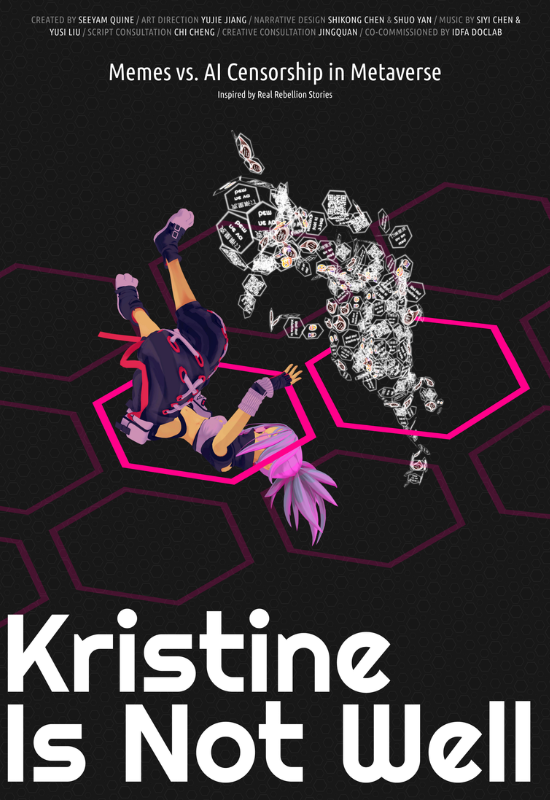
Platforms like Instagram, TikTok, X (formerly Twitter), and many more social media sites turn everyday users into performers—curating identities one post at a time. We build personal brands through filtered photos and “relatable” videos, crafting versions of ourselves for an audience we may never meet. But where does the digital persona end, and where does the real self begin? Kristine is Not Well, a VR experience by Seeyam Quine, pushes this question to its limits. It asks: Who is really in control—the person, the avatar, or the algorithm watching them both?
As someone with an interest in finding what ultimately makes us human, I have been continuously immersing myself in non-human worlds—the virtual and fabricated ones of VR. However, sensing and understanding humanity translated through them has been quite the “fieldwork” experience. And Kristine is Not Well is no exception to this. Although Kristine is Not Well and Owlet are completely non-human interactions—the only true human present is you—there is still a strong sense of humanity, community, real-world, and life experience in the VR narrative.
Start the Scroll
This VR experience was approximately twenty minutes long and arguably the most interactive narrative I’ve gone through thus far. This experience has you constantly commenting—using your held controllers to hand track you pressing a hexagonal, shiny button on your virtual dashboard—on the influencers you cycle through on the social media platform, Owlet, that you are transported into for the entirety of this experience. Owlet is designed for “only positive energy,” where the comments you can make for each of the influencers are fixed and tailored to the content you are viewing; little reactions such as fire emojis, mindblown emojis, “cute”, “——— Rules”, and so on. And as you’ll see, they are more or less the same for each onlooker to post.
I, in reality, was standing in the middle of my room for this experience. However, in Owlet, it looked like I was suspended in the air along with the other “viewers”, who looked no more than stick figures, with a hexagon button in front of each of them that would rush forward when they “leave a comment”. Top to bottom and wrapped around in a circle, each of the viewers and you fills the sides of the virtual space. At the center of all of us are the influencers, whose posts appear before us, spotlighted and accompanied by colorful backdrops that fill the remaining area of the virtual world. The style of the VR vaguely reminds me of the Colosseum—much more digital and colorful, mind you—where you and the other excitable spectators of this social media culture are surrounding the sides of the virtual amphitheater to watch the scrollable spectacles of the day.
It feels familiar, this social media app—scrolling through influencers, reacting to posts, and engaging with content—only this time, you’re wearing a headset instead of holding a phone.
Meet your Media
The feed you encounter on Owlet is quirky and surreal, a real hodgepodge of characters that each have their own niche and artful avatar designs. The premier influencer I experienced was a statuesque, muscular, and toned canine who, in having such an impressive physique, had a cutesy face design. This fit and friendly pup was modeled as a fitness influencer, and encouraged you into a ‘10 minute leg & booty workout’, which I did try to follow along to as I had stood all day at work, and it was a nice movement break in the afternoon. After my short “workout”, I came across more influencers who had similar media slots to those commonly seen on TikTok or Meta Reels nowadays. There was a pigeon character sporting a little police hat, who, despite being able to fly, rode a drone while telling recent crime stories. This influencer had the most detailed backdrop, depicting a crime scene set in what looked to be a library or office, complete with caution tape and chalk outline, to enhance their crime detective persona further. To prompt engagement from the viewers, he asked us to comment a scare rating, out of ten, to the tale he summarized in his post. Next in the rollcall of content creators were a pair of reindeer that, between themselves, went through a mini lesson in speaking French. But after the two bilingual does, there was a dance trio of Nosferatus, who caught me extremely off guard. Even in the rush of seemingly ridiculous characters, in no way did I expect to come across this undead dance group—in all honesty, however, they were my favorite personalities in this experience, and I couldn’t help but try to dance along, even though I couldn’t keep up.
There were quite a few Owlet influencers throughout this experience that you watch, but most importantly and popular on the site is Kristine. Known as @KristineMusic on the platform, her virtual avatars perform her pop songs for her many engaged followers. Kristine uses three avatars: one appears to be at a DJ station, one on a Guzheng, and then the leader Kristine, who, in one music video, plays a large suspended gong. Her music is both an expression of her talent and part of her culture, as seen with the musical instruments she features. Some of the other influencers on Owlet interact with Kristine’s music. A fan posts about the new music and expresses their liking of the artist, and the Vampire Squad even dances to her music.
It feels playful, even absurd, world-hopping through Owlet. But as you immerse deeper, the tone shifts. Kristine shows up on the feed once more, but is not performing. This time, she speaks about leaving the site for a while to connect with herself instead of the avatar everyone knows her as. It’s common for people to get lost in music; however, Kristine was performing so much as someone else that she started to lose herself.
Avatar and Avoidance
Facelessness is common among influencers. It offers anonymity, privacy, and a buffer against scrutiny. Kristine’s avatar embodies this strategy—a digital mask that performs her music while shielding her real identity and herself from any threats that may come to her. When Kristine posts her “farewell”, she speaks about how she used the avatars because of her worry about discrimination towards Chinese people in the COVID era. Acts of violence, hate speech, and overall downlooking were common; she used the avatars as a front to still be able to express herself and share her music in a way that played into the stream of society.
Anthropologist Erving Goffman described “personal fronts”—the ways we present ourselves through clothing, gestures, and expressions. Online, those fronts become avatars, filters, and curated personalities. We perform constantly, whether metaphorically or literally. In Kristine’s case, it is both: she performs music and performs identity, crafting a version of herself that feels safe yet disconnected. These aspects of “personal fronts” feed into our “presentation of self”—another Goffman concept—that refers to the way people manage the impression they leave on others. This is an intentional management we do depending on the social or cultural context we find ourselves in. These are not necessarily “faked” personas but rather differentiating aspects of the self, and are a normal part of social life. A person will “play” many roles throughout the course of their life. Just think about yourself, how do you present yourself at school or work compared to with your close friends or family? Or even on social media?
Ultimately, more often than not, personas or characters that are crafted by people are not only an aesthetic choice, but personal ones, meant to draw out or extend their personalities, creating an image that they find confidence and power in when “performing”. In Kristine is Not Well, I found Kristine making a similar attempt and being fairly successful at it as well. Identity creation, especially online, is highly varied from person to person. After all, everyone is different, and the way each person chooses to present themselves is unique. We try to maintain tight control of our image, though occasionally it may slip away from us at times.
Takeover of Control
When Kristine departs, Owlet’s empire trembles. She’s their star, their algorithmic anchor, their revenue stream. So they do what many platforms would do if ethically unrestrained: they take over her account. However, algorithms can mimic content, not essence. Viewers and fellow influencers quickly sense the uncanny rhythm of a fake. Concern spreads. Stories multiply. You scroll through frantic speculations until a desperate message from Kristine appears on a new account for the platform, confirming what everyone feared. Owlet had taken over Kristine’s original account and started producing content to keep viewers engaged with the platform. Someone, or something, was even after Kristine outside the app. Her desperate plea for help sparked even more fiery posts from other influencers and comments from us viewers.
This is where the VR experience reveals its teeth. Kristine’s story becomes a metaphor for censorship—subtle at first, then blindingly direct. The narrative parallels the real-world tactics used by Chinese netizens to evade censorship during COVID-19: coded language, memes, and art as resistance. Algospeak emerges—carefully bent words and symbols that slip past moderation bots.
In the VR world, you’re encouraged to comment “Kristine is Not Well” in as many encrypted forms as possible: emojis, alternate alphabets, Morse code, QR codes, foreign language. Owlet tries to delete them, but some of the encrypted messages survive. Layer by layer, the community builds a digital figure, much resembling Kristine, when her avatar hits the gong, against the algorithm attempting to silence them. The figure hits Owlet from the air of the virtual space, sending the code to break apart and shut down. It’s one of the rare moments in VR where you genuinely feel collective action—where the platform’s collapse becomes a victory, not a glitch.
Screen Time Limit
Social media promises connection and expression, but it also quietly reshapes us—nudging, tracking, categorizing, manipulating. Kristine is Not Well doesn’t scold or condemn; instead, it reveals the dynamic we’re already complicit in. We perform. We watch others perform. And sometimes, we forget which version of ourselves is the one living our life.
Kristine got lost somewhere between avatar and self. Not because she was weak, but because platforms are engineered to blur that boundary. To be endlessly online is to be endlessly performing. And yet, the VR experience leaves you with something gentler: a reminder that humanity still requires presence. That identity can’t only be curated; it must be lived. That we only understand people—others or ourselves—by inhabiting the world alongside them, not just scrolling past their avatars.
To be well, we have to recognize this part of the feed. We must remember that life is not an algorithm but an experience. And that understanding humanity requires more than just a scroll: We have to experience it firsthand.