
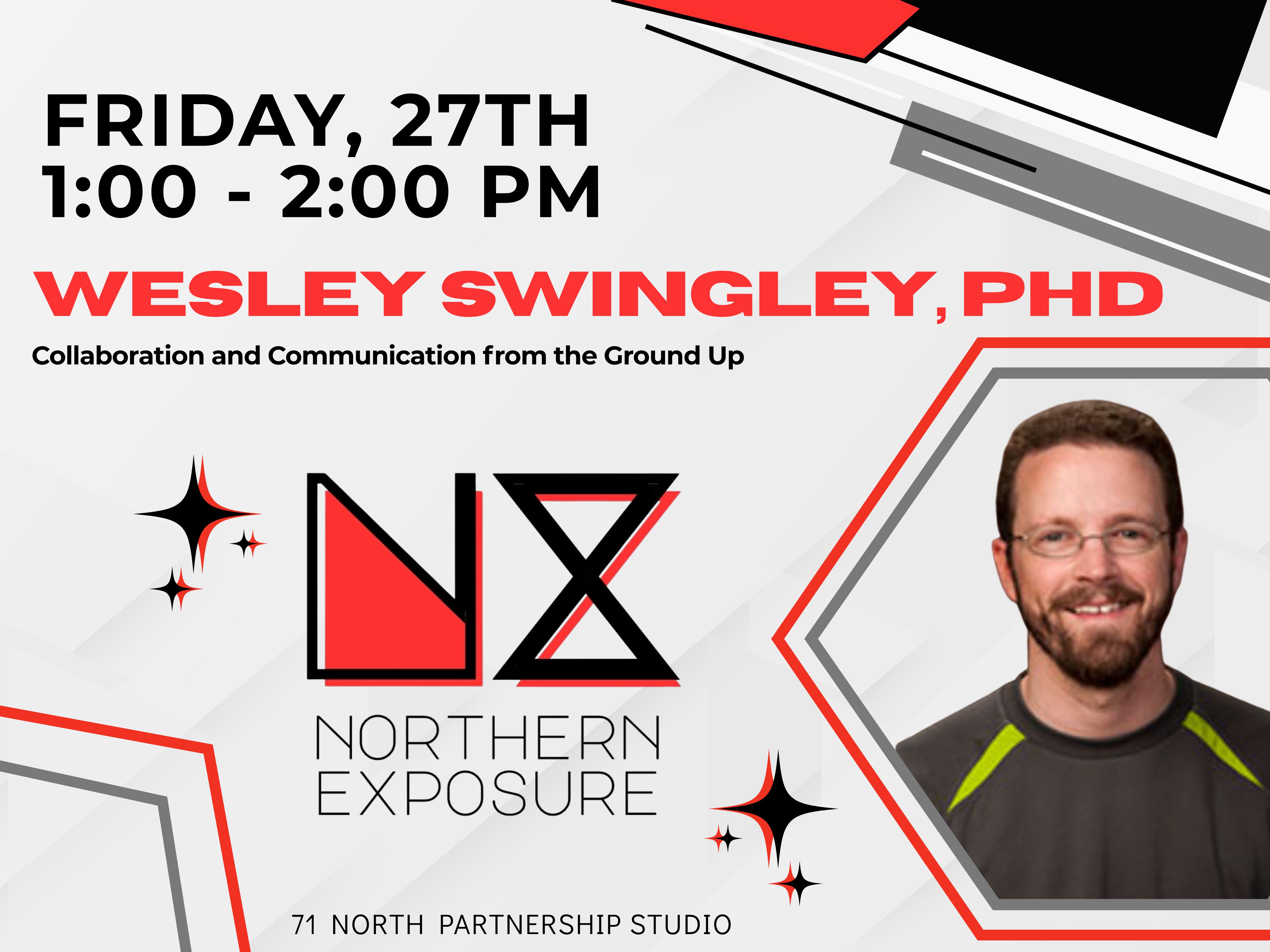
For our Northern Exposure this week, we had the pleasure of having Dr. Wesley Swingley, from the Department of Biological Sciences, self-proclaimed technophile and man of many hobbies, present to us a brief introduction to the work he has collaborated on and some of the communication fostered throughout.
Dr. Swingley began sharing some of his background and upbringing. Being raised in a very small town in Montana, he found interest in discovering what there was and what was unfamiliar. Additionally, growing up in the 80’s with the rise of the computer and new technologies, he found a pastime in coding books for video games such as Rogue. Later in life, Dr. Swingley traveled to Cleveland, Ohio, for college, and then to Phoenix, Arizona, for graduate school. Further inspired by his favorite quote by Mark Twain, “Travel is fatal to prejudice, bigotry, and narrow-mindedness, and many of our people need it sorely on these accounts,” Dr. Swingley then spent time living in Japan.
Delving into some of Dr. Swingley’s work, he found that when looking at genes and DNA, although we want to know things, we might not have the qualifications to work on such a project, which leads us to collaboration! Additionally, an interest in the Mars Trilogy series by Kim Stanley Robinson, about hard sci-fi and the evolving Martian atmosphere, led him to collaborate on his first project at NIU. The project centered around the “Habitable Zone”, the region around a star where temperatures are just right for liquid water to exist on a planet’s surface, and algae that are responsible for producing oxygen. The goal of this project is to observe whether or not life is possible on other planets, such as Mars.
The second project Dr. Swingley shared with us involved prairies around Illinois and their restoration. The main problem with restoration attempts, as has been observed, is that there is a complex web of factors, such as carbon and nitrogen levels, seasons, and bison, that contribute to the livelihood of prairie landscapes. Dr. Swingley shared some of the data charts collected on these interlocking factors and the usage of decision trees in situations such as prairies, where factors are so easily affected and affected by one another.
A third project Dr. Swingley touched on, and has been recently collaborating on, has been the documentary Life Unearthed with Ariel Waldman. This is a “science-driven docu-series that reveals Earth’s ecosystems through radical shifts in scale—from microscopic wildlife to the planet’s most iconic animals—and even the possibilities of life beyond Earth”. The premiere of which will be airing on PBS this April. With the creation and airing of this documentary, Dr. Swingley hopes that the series will not only have success promting additional seasons on PBS, but also to further funding within this line of research.
All in all, Dr. Swingley commented on the fact that the collaboration that has been fostered between him and colleagues has brought him some of the funnest experiences and kept him humble, reminding him that sometimes you aren’t the smartest person in the room, and you can always learn from other people. Swingley finished off his talk with us with some questions we should all consider about collaboration in the near future.
Will we need collaboration in a world of AI? How can AI be used to find hidden data? Outreach? How can we foster collaboration in a way that gets future generations of people to think outside the box?
Dr. Swingley also provided us with some very important and wise words of wisdom. Reminding us that it is never a matter of being “smart enough” but a matter of finding a way and the courage to get involved. Additionally, when working on a project or with other people, you may hear a lot of no’s, but it is the yes’s you must focus your attention on and seize the opportunities that come to you. Finally, if you find yourself wanting to work on a project or work with or in a certain sector, just email people! Reach out and express your interest; making decisions and acting on things is better than never knowing if the decisions were worth making.