
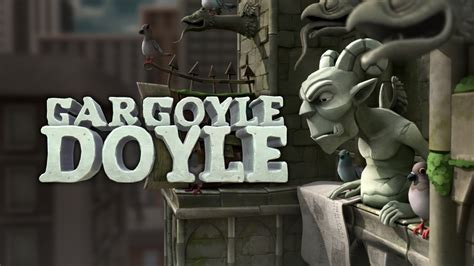
There is something quite humbling about being face-to-face with a creature that has outlived empires.
At first glance, Gargoyle Doyle, published by easyAction, might seem like a whimsical animated VR comedy — a lighthearted buddy story about two unlikely cathedral fixtures. But once you step inside its immersive world, it quickly becomes clear that this experience carries real emotional and cultural depth. This is not a story that unfolds on a screen in front of you; it unfolds around your body. The cathedral rises. Light shifts. Stone breathes. History stops feeling distant and suddenly feels personal.
What Gargoyle Doyle does especially well is invite you to slow down and sit with time — not time measured in minutes or hours, but time measured in centuries. Gargoyles and bells are not simply decorative here; they are witnesses. They have watched as generations of humans have arrived, worshipped, protested, decayed, rebuilt, and left again. Through VR, you don’t just observe that history — you occupy space within it.
In the experience, you meet Doyle, a stone, grotesque gargoyle who has spent roughly eight hundred years wedged into a forgotten alcove of St. Norvil Cathedral. Damaged during installation, he was denied the grand placement he believes he was carved for. Beside him is Chet, an eternally cheerful copper rain gutter whose optimism feels almost out of place among the gray stone. Together, they offer a surprisingly thoughtful exploration of identity, expectation, endurance, and companionship — all experienced in ways that only VR can deliver.
The Museum
The experience lasts roughly forty minutes and is designed to be played seated, using hand tracking rather than controllers. I sat in my playspace, ready for the experience to begin. Once it did, I was transported inside St. Norvil Cathedral Museum — a quiet, carefully arranged space that immediately set a slower pace.
Directly in front of me was a miniature diorama of the cathedral as it once stood, every flying buttress and tower reduced to a scale I could take in at once. Behind it hung a cracked copper bell, suspended slightly from the ceiling, its surface dulled by age. Gargoyle spouts protruded from stone walls, dripping water into a shallow basin that echoed softly through the space. To my left stood a carved statue of Mary and Joseph holding the infant Jesus, their expressions frozen in reverence. Between them, a stained-glass window filtered soft, colored light across the room. Nearby sat chisels, stone blocks, and tools once used to carve the cathedral’s exterior — worn smooth by the hands of centuries. Then, to my right, a plaque stating the name of the museum, a lone arm of another grotesque gargoyle, and a wooden box sat on top of a carved shelf with a sign reading “Exhibit Under Construction”.
Nothing here asked to be rushed. The museum felt less like an exhibit and more like a pause — a place where objects quietly waited to be noticed. This space works as a bridge between worlds, reminding you that history is not gone; it is simply rearranged.
Between yourself and the diorama stood four buttons labeled with different eras of the cathedral: Construction, Cathedral Life, Modern Era, and Demolition. Pressing any one of them caused the museum to dissolve around you, as if the walls themselves were made of memory.
Construction
When you select the Construction era, the clean museum floor melts away. Wooden scaffolding rises around the exterior of the diorama cathedral. The sound of hammering and distant voices fills the air. You begin to float upward and outward, no longer anchored to the room — instead drifting like one of the pigeons that appear throughout the experience.
Below you, masons work methodically, chiseling stone and hauling materials. The cathedral is incomplete, skeletal, and alive with movement. As you drift closer, your attention is drawn upward to the scaffolding at the front of the structure.
There, Doyle is being hoisted into place. Sunlight catches his carved features as he delivers a proud speech about his craftsmanship, his importance, and his intended position. He believes — fully and confidently — that he knows exactly what he was made for. The moment feels ceremonial, almost triumphant.
Then the sound shifts.
The bell tower begins to ring, louder and louder, until one bell breaks loose. Time slows as it falls. The bell crashes into the scaffolding, striking Doyle down. You watch helplessly as he plummets, landing hard on the cathedral steps, the bell crashing down atop him. His stone shoulder chips. One wing cracks. The scaffolding above continues without him.
As a player, you cannot intervene. You can only watch. That helplessness is important. It mirrors how sudden, unchosen moments can permanently redirect a life. Doyle’s fall is not just physical — it is the moment where expectation fractures.
When the scene ends, you are gently pulled back into the museum, left to sit with what you just witnessed before moving on.
Cathedral Life
The Cathedral Life era brings you back out into the world again, but now the building stands complete. The surrounding land is fuller, fields cultivated, homes clustered nearby. Bells ring regularly, marking time not by calendars but by sound.
Doyle, however, is no longer at the front. Instead, you find him tucked into a narrow alcove toward the back of the cathedral, hidden from view and sunlight. Other gargoyles perch nearby, speaking in sharp, limestone squawks that Doyle cannot understand, nor bothers to.
It is here that Chet enters the story — a copper rain gutter attached awkwardly beside Doyle. He gleams slightly, standing out against the gray stone. From the start, Chet is talkative, curious, and has quirky optimism. Doyle, on the other hand, is bitter, embarrassed, and furious about his placement.
As rain begins to fall, water rushes through Chet, supposedly fulfilling the purpose he was built for. Bells ring again, and Chet hums along to their rhythm. Doyle grumbles.
Then time stretches. Weeks pass. Then years. Then, hundreds of years. The bells ring again and again, and Chet sings along each time. Pigeons come and go. The town below grows and changes, but the alcove remains relatively the same. The repetition becomes almost meditative. From this fixed position, history doesn’t rush forward — it circles.
As a player, you float close enough to see small changes in the stone, hear shifts in sound, and notice how the world evolves while Doyle and Chet stay put.
Modern Era
The shift into the Modern Era is abrupt and disorienting. One moment, the cathedral stands at the heart of a living town; the next, it is wedged into a dense cityscape that has grown up around it. Roads of dark asphalt replace dirt paths. Buildings rise taller than the bell towers. The air feels heavier — filled with sirens, engines, distant shouting, and the constant hum of modern life.
From your floating vantage point, the cathedral no longer feels monumental. It feels overlooked.
The alcove where Doyle and Chet have spent centuries is now cracked and stained, moss creeping across the stone like time made visible. The once-clean edges are softened by decay. Yet from a small fracture in the wall, a single yellow daisy pushes its way outward. It is easy to miss, but once you notice it, it becomes impossible to ignore — a quiet reminder that life persists even in places deemed obsolete.
Chet, as always, adapts. He has fashioned a makeshift fishing rod and spends his time hooking garbage bags from the street below. As he opens them, familiar objects spill out: smartphones, board games, children’s toys, random household items. These are objects we recognize instantly — not as antiques, but as things from our own lives. Seeing them treated as refuse feels oddly intimate.
Rather than dismissing them as trash, Chet carefully stores these items in his small cupboard. One object in particular stands out: a Teddy Ruxpin, its fur worn and outdated. Chet repurposes the bear’s tape recorder to capture thoughts and conversations, turning discarded technology into a tool for memory. What humans threw away without a second thought becomes an archive of lived experience.
Below, a group of protestors gathers near the cathedral, chanting in opposition to a proposed power plant. Their voices echo upward, mixing with the city’s noise. Doyle scoffs, commenting on humanity’s obsession with crisis and catastrophe. To him, these moments blur together after centuries of observation.
Chet responds by mentally flashing through earlier human struggles — famine, plague, revolution, war. His point is simple: hardship is not an exception in human history; it is the pattern through which change happens. Progress, messy and imperfect, emerges from moments of unrest.
Doyle counters with quiet confidence: “Flesh rots. Metal rusts. But stone, stone lasts.”
It’s a powerful line, and for a moment it feels true. From Doyle’s perspective, humans are fleeting while he remains. Yet the scene itself subtly challenges that belief. The stone around him is cracked. The city has outgrown the cathedral. Permanence, it seems, is not the same as relevance.
As a player, you hover between these perspectives, watching history continue to move — whether the cathedral is still there or not.
Demolition
The Demolition era removes any remaining illusion of safety. Heavy construction equipment surrounds the cathedral, pressing close to the alcove. A massive wrecking ball hangs nearby, suspended in a way that feels deliberate — like a held breath before impact. The protestors are gone. The decision has already been made.
At first, Doyle seems not to care. He sits with a newspaper, attempting normalcy amid looming destruction. The moment feels almost mundane — until he notices the headline announcing the cathedral’s demolition and replacement with a power plant. Suddenly, the abstract threat becomes real. Doyle’s fear is not dramatic at first; it settles slowly. He begins to spiral, imagining himself crushed, repurposed, or entombed as foundation material. For someone who once believed stone was eternal, the idea of being erased is unbearable.
Chet, meanwhile, learns that he will be saved, removed, and restored to his original function as a bell clapper. What should be good news becomes a point of rupture. Old resentment resurfaces, and the truth about their shared past comes spilling out: Chet’s pride once caused him to ring too fast, knocking the bell loose and triggering the accident that damaged them both and trapped them in the alcove.
The argument escalates. Doyle, overwhelmed and angry, grabs the same pickaxe he once used to try to free himself centuries earlier — a tool that has always represented escape and self-destruction. In a moment of despair, he turns it on Chet, only to realize how pointless the action is. No amount of anger will change what is coming. Eventually, exhausted, they fall silent. Night passes. Rain falls again.
In the middle of the night, the bulldozer strikes. When Doyle wakes, Chet is gone.
At first, Doyle tries to ignore the absence, clinging to anger as a shield. But time stretches, and the space beside him remains empty. The alcove feels colder. Quieter. The loss becomes undeniable.
It is then that a broken gargoyle nearby begins to call out to him. At first, she speaks in the language of limestone, which Doyle never bothered to learn. When she switches to English, her words are gentle but firm. She reminds him that while stone may last longer than flesh or metal, it also breaks harder — and does not heal on its own.
“Flesh will heal, even metal can bend, but stone breaks hard and stays broken, unless, of course, we have someone to pick up the pieces.”
For the first time, Doyle understands what he has been resisting all along: endurance without connection is hollow. Grabbing the pickaxe once more — this time not to destroy himself, but to free himself — Doyle chips away at the stone holding him in place. He breaks free, rolls down the cathedral’s structure, and lands in the wet concrete below. There, half-drowned and nearly lost in flowing concrete, is Chet. Doyle lifts him free and throws him to safety, choosing his friend over the illusion of permanence.
The cathedral will fall. That cannot be stopped. But, meaning suggests, the experience is not found in lasting forever — it is found in who we choose to hold onto when everything else is coming apart.
Reassembling the Past
After the chaos and destruction of the demolition, the world does not fade to black. Instead, it settles.
You find yourself once again inside the St. Norvil Cathedral Museum — the same room you began in, yet it no longer feels neutral. Now, it feels haunted by everything you’ve witnessed. The air is quieter, heavier, as though the space itself remembers what it once was.
The objects around you begin to change. The gargoyles mounted high on the walls shift subtly, stretching stone wings and turning their heads. The statue of Mary, Joseph, and the infant Jesus stirs, their expressions softening as they look outward rather than downward. It feels uncannily similar to Night at the Museum, yet the tone here is not playful chaos — it is reverence. These figures are not coming to life for spectacle; they are acknowledging survival.
A narrating voice, familiar now, fills the space. You recognize it as the broken gargoyle that spoke to Doyle during the demolition. In this setting, her voice feels less like narration and more like memory — as if the museum itself is speaking through her. Your attention is drawn to the cracked copper bell hanging in front of you. A soft glow highlights it, and you are prompted to reach out. Using hand tracking, you press the bell’s button and gently lift it from its resting place. As it rises, the space behind it opens, revealing Chet restored to his proper position as the bell clapper. This time, when the bell rings, it does so at the right pace.
The sound is full and measured, echoing through the room without urgency or panic. It feels intentional — a rhythm reclaimed. After centuries of disuse and chaos, Chet is finally doing what he was made to do, but without the pride or recklessness that once caused so much damage.
Then, from the wooden box labeled “Exhibit Under Construction” on the shelf beside you, a muffled voice calls out. You watch as the box shakes, cracks, and finally breaks apart. From inside emerges Doyle — dusty, confused, but whole. He looks around in disbelief before locking eyes with Chet. Their reunion is quiet, almost understated, but heavy with relief. No dramatic declarations are needed; their presence beside one another says enough.
Doyle reflects aloud on his time encased in concrete — on the strange clarity that came from being completely still. He speaks of watching his own carved form slowly disappear as it was remolded into a block of travertine. His sense of identity, once tied to a specific shape and purpose, dissolved along with it.
The space around you begins to shift again.
The Carving
The museum melts away, replaced by the familiar setting of a mason’s workshop — echoing the Construction era where Doyle’s story began. Stone dust floats through the air. Wooden tables are scattered with chisels, sketches, and half-finished designs. Sunlight filters in through an open window, illuminating a large block of travertine at the center of the room.
Drawings hover in the air around the stone. Each depicts a different gargoyle design — wings flared, expressions fierce or noble — yet none of them quite match Doyle. These are the expectations that were once placed on him, visible now as possibilities rather than instructions.
Resting atop the block of stone is a pickaxe — the same tool that once symbolized Doyle’s despair. This time, however, it carries a different weight. When you lift it using hand tracking, the action feels deliberate and physical. You are no longer watching history unfold; you are participating in it.
With each careful strike, pieces of stone fall away. Doyle’s form begins to emerge, not as the flawless gargoyle once envisioned by his creators, but as the version shaped by centuries of experience. Chips reveal familiar curves, scars, and imperfections. This is not restoration — it is reinterpretation.
The act of carving is slow. Intentional. There is no rush.
As you work, the experience quietly reinforces its final message: identity is not something completed at the moment of creation. It is something shaped over time, through fracture, adaptation, and choice. Doyle is not being returned to what he was meant to be — he is becoming who he is.
When the carving is complete, Doyle stands revealed — not perfect, not pristine, but fully himself. The workshop fades, leaving you with the sense that something old has ended and something honest has begun.
What Remains
Gargoyle Doyle might wear comedy on its stone face, but underneath it’s a meditation on presence, history, and what it means to find companionship in the margins of existence. It takes what could have been a simple VR cartoon and turns it into a shared cultural journey — one that invites reflective engagement rather than passive viewing.
If immersive storytelling is the next frontier in human narrative, experiences like Gargoyle Doyle are a promising first step. They show us that when technology and anthropology intersect, the result isn’t just entertainment — it’s a new way to see humanity itself. Of all the immersive experiences I’ve encountered so far, this one stayed with me the longest. I find myself mentally returning to the story, and when I think about what immersive storytelling can do. The amount of humor, wit, and real-world wisdom within it was so endearing and inspiring, and like some of the past VR has prompted me to look at my own life and reflect on how I can personally grow, similar to how Doyle did.
In a world obsessed with speed and visibility, Gargoyle Doyle asks a quieter question: If we are no longer bound by the expectations set for us long ago, who do we choose to become?
And perhaps that question — carved into virtual stone — lingers long after the headset comes off.