
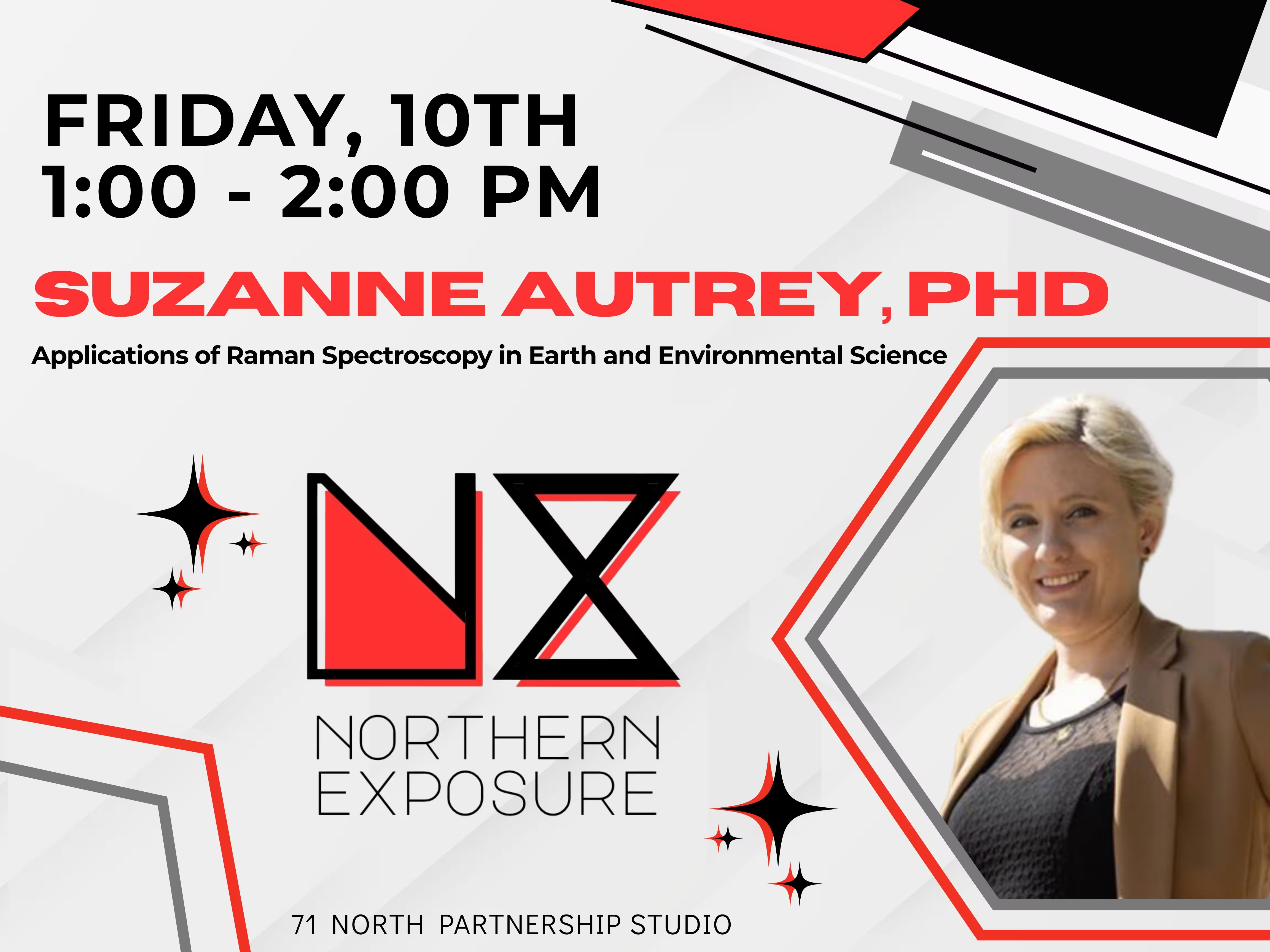
We are sad that Northern Exposure is done for the semester, but we were so happy to have had Dr. Suzanne Autrey be our presenter for the finale of NX. Dr. Autrey gave us a talk on applications of Raman Spectroscopy in Earth and Environmental Science!
Dr. Autrey started by telling about Raman spectroscopy, which is a non-destructive technology used in studying biomaterials and other delicate samples. Raman spectroscopy uses inelastic light scattering, or the Raman effect, to analyze molecular vibrations to identify chemical structures and compositions of samples. Dr. Autrey explained that this technique is used in many fields such as pharmaceuticals, archaeology, food analysis, cancer detection, and many more. Dr. Autrey is also hoping to enhance the lab here at NIU by getting Renishaw InVia Qontor, a top-rated and best-selling Raman microscope capable of spectroscopy, mapping, and live focus/topography tracking.
In Geology, using Raman spectroscopy allows for mineral maps of materials such as volcanic rock and identifies materials as well. Additionally, Raman can help in Geobarometry, Geothemonetry, high-pressure and temperature experimentation, and microplastic research. Dr. Autrey touched on a method called RSCM Geothemonetry, or Raman Spectroscopy of Carbonaceous Materials, which is used to estimate the maximum, or “peak,” temperature that sedimentary or metamorphic rocks experienced during their history.
One of the bigger techniques Dr. Autrey focused on was QuiG (Quartz-in-Garnet) Geobarometry, which she has used since 2017 during her PhD studies. This technique functions by analyzing the remnant strain, or the difference in volume and shape change, between a quartz inclusion and the surrounding garnet host as they are brought from deep within the Earth to the surface. This technique is also better at detecting small shifts in rock formations and can cover a whole bunch of differnt areas to see how the material formed. Dr. Autrey mentioned two examples where she used QuiG Geobarometry, one of which was in the Funeral Mountains metamorphic field gradient, where the big question was, “How do we test to see how it formed? “ To do so, a mix of RSCM and QuiG technologies was used to see the processes of formation and deformation of rocks. The second study was in the Depth of the Precambrian Basement of the Grand Canyon, where blocks of rock formed at differnt temperatures. In this study, they were able to debunk the original ideas of the thermology of the Canyon and reconstruct the temperature history, enabling a reunderstanding of how temperature settings formed and deformed the rocks.
Some new work for Dr. Autrey lies in the desert, looking at schist in Los Angeles and Phinox, where new tools with higher resolutions can give new insight into how the rocks formed. Dr. Autrey is also currently pursuing funding for pressure-temperature experiments on piston cylinders, where the attempt is to synthesize garnet and expand to critical mineral systems to see economic deposits.
Dr. Autrey ended her talk by answering some questions from the audience and stressed how she would love to do more collaboration at NIU and overall. We wish Dr. Autrey luck in her funding pursuits and can’t wait to see what more we can learn from Raman technologies. Overall, the Spring Northern Exposure Finale “rocked”!