
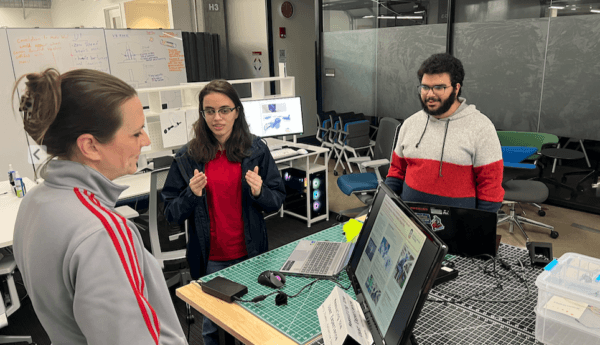
For Jerry Stamos, the work he presented with fellow NIU engineering student Katherine Davenport earlier this week at the Conference on Undergraduate Research and Engagement (CURE) wasn’t really about hardware.
It was about a feeling—and, at times, the lack of one.
Stamos, a junior mechatronics engineering major from St. Charles, got involved with the Vespa Mode project inside NIU’s emerging Huskieverse ecosystem with what seemed like a clear objective: help build a more functional, responsive and believable virtual reality riding experience.
But the early version sputtered.
“The controls just didn’t feel good to use,” Stamos said. “We also had issues where the Quest controllers would lose tracking mid-game, and the player would completely lose control.”
Fixing that meant going deeper than expected.
The project itself had already been reframed by the time Stamos and Davenport dug in. What began as a simulator had shifted into something more abstract. With a Vespa scooter brought into the studio as physical inspiration, the team wasn’t just thinking about mechanics. They were thinking about motion, posture, rhythm—what it actually feels like to ride.
For Federico Bassetti, NIU’s assistant director for innovation ecosystem development, who helped guide the effort, that distinction matters. A Vespa Mode riding experience isn’t defined by speed or torque, but flow. So the focus shifted from behaving like a scooter to creating the feeling that it rides like one.
For Stamos, that shift translated into a very specific kind of engineering work—bridging messy human input and a system that has to respond cleanly. His approach touched both sides of the equation.
“On the hardware side, I’m adding sensors and designing custom mounts for them,” he said. “On the software side, I have a custom program that takes input from the sensors and shares it over UDP with the VR simulation.”
One of the biggest challenges was physical; because the original rig wasn’t designed with any additions in mind, even simple changes have been difficult.
“Working around the existing design was probably the hardest part,” Stamos said. “It mostly came down to repeated iteration.”
That’s meant prototyping, testing, adjusting—then doing it again. The Huskieverse studio’s 3D printers have been essential, allowing Stamos to quickly create and refine custom mounts for sensors that didn’t have an obvious place to go.
His system is designed to be more reliable than what came before, while also opening the door for new features—like separating handlebar rotation from leaning input, or eventually integrating a gear shifter to deepen immersion.
Not all of the unknowns are solved.
One concern is durability. The throttle system relies on potentiometers, which wear down over time. Stamos expects the setup to last through hundreds of sessions but he acknowledges there’s no hard data yet. Future iterations may shift to magnetic encoders—more precise, longer-lasting and easier to maintain.
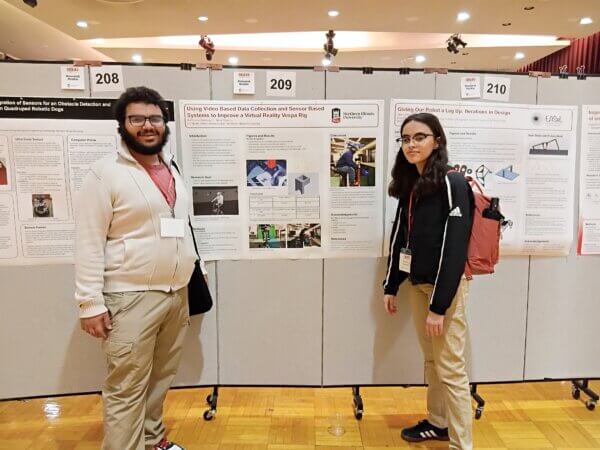
Known as “Using Video Based Data Collection and Sensor Based Systems to Improve a Virtual Reality Vespa Rig,” a part of the larger “HuskieVerse” project, the project has benefited from its collaboration with Adam Bougher, a graduate student in computer science and Oliva Barnes, whose background in anthropology introduced a different set of questions. Together, the team began looking at how virtual experiences create emotional responses—how sound, visuals and motion combine to shape perception.
Why does a certain environment feel calming? Why does another spark tension—or even joy?
That line of thinking pushed Stamos into experimenting with sensors that can capture brainwave activity, exploring whether emotional responses could eventually be measured alongside physical input. The early-stage work reflects the project’s broader direction toward understanding the human experience around the machine.
That philosophy shows up in smaller ways, too.
When asked how a rider would notice the difference in his system, Stamos didn’t point to a specific feature or metric.
“To some extent, it’s not about noticing a difference,” he said. “It’s about not noticing one.”
In the earlier version, users had to think about how to control the system. It felt awkward. Some experienced motion sickness. The goal now is something quieter—controls that fade into the background, where interaction feels natural enough that the user stops analyzing it.
Across the project, that same tension keeps surfacing: responsiveness versus realism, innovation versus reliability, technical accuracy versus human perception. As Bassetti noted, making something believable often matters more than making it exact.
Vespa Mode has grown into a collaboration that reflects that complexity. Multiple senior design teams from the College of Engineering and Engineering Technology have contributed to the physical platform over the past two years.
Software developers refine control systems. Students in the arts explore sound, animation and visual design, while physics and engineering intersect in ways that don’t fit neatly into one discipline.
“It’s an infinite game,” Bassetti has said. “The more angles we explore, the more possibilities emerge.”
That openness is part of what keeps the work grounded. There’s no single endpoint—just a series of improvements, questions and iterations.
If there’s one takeaway Stamos hoped people left with after seeing his work this week, it wasn’t about VR or scooters.
Instead, he said, “You can use low-cost components and tools to quickly develop novel solutions to real problems.”
Built on constraints, workarounds and incremental progress, Vespa Mode might just be the quintessential metaphor for the uneven odyssey that engineers take every day to attain their goals.